Free Tool · No Credit Card

AI Search Visibility for Real Estate Investors, Measured Monthly Across Six Platforms

We build the entity, content, and schema signals that make AI engines cite your business, then measure your citations every month across ChatGPT, Claude, Google AI Overviews, Gemini, Copilot, and Perplexity, and show you exactly which prompts you won and which you lost.

5,100%
Organic lead lift, Four 19 Properties, DFW
2,200%
Leave The Key, Long Island NY
2,100%
Cream City, Milwaukee
6
PAI platforms tracked monthly
Definition

What Is AI Search Visibility for Real Estate Investors?

Quick Answer

AI search visibility for real estate investors is how often ChatGPT, Claude, Google AI Overviews, Gemini, Microsoft Copilot, and Perplexity name your business when a motivated seller asks who buys houses in their market. It is measured by citation frequency, prompt coverage, and share of voice against in-market competitors, and it is earned through structured content, complete schema, a verifiable entity cluster, and corroborating off-site signals rather than through keyword rankings. Reibar builds those signals and reports the score monthly across all six platforms.

Classic SEO asks whether you rank. AI search visibility asks whether you get named.

Those are now two separate outcomes and one does not guarantee the other. An investor can hold position one for 'sell my house fast [city]' and still be entirely absent when a seller opens ChatGPT and types the same thing as a question. We see it in baseline audits constantly: strong Ahrefs profile, healthy Search Console, zero citations across all six platforms.

The mechanism is different. Rankings are earned by relevance and authority against a query. Citations are earned by an engine deciding your business is a real, verifiable entity that it can safely name in an answer. Those require different work.

The Investor Difference

Why Real Estate Investors Cannot use Realtor AI Visibility Advice

Nearly every article written about AI search visibility in real estate is written for agents. It is worth understanding why almost none of it applies to you.

01

The audience is inverted.

Realtor content optimizes for buyers asking about neighborhoods, schools, and which agent to hire. Your audience is a homeowner in distress asking how to stop a foreclosure, whether they can sell an inherited house before probate closes, or how to get out from under a rental with a tenant who will not leave. Different questions, different engines triggered, different sources cited.
02

The queries carry urgency, not research intent.

A buyer researching neighborhoods asks broad, comparative questions over weeks. A seller facing an auction date in nineteen days asks a narrow, urgent question once and acts on the answer. That compresses your window to a single conversation, which is precisely why being inside the answer matters more in this vertical than in almost any other.
03

Portals are not your competition.

Agent AEO advice is built around escaping Zillow and Realtor.com. Those portals barely feature in motivated seller answers. Your competition is the other cash buyer three miles away, and increasingly the national iBuyer with a bigger entity footprint.
04

Nobody publishes seller-side data.

Every statistic on every competing page describes home buyers. The National Association of REALTORS number about buyers researching online tells you nothing about a probate heir in Milwaukee. We stopped trying to borrow buyer data and started measuring what actually happens in our clients' markets instead.
05

The six seller situations are the real query map.

Foreclosure, probate, divorce, inherited property, tired landlords, and distressed property. Each generates its own cluster of AI prompts, each gets answered by a different mix of sources, and each has to be won separately. A general "AI visibility" program will not touch them.
The Diagnosis

Why Your Business Is Missing From AI Answers, and Why Rewriting Pages Will Not Fix It

This is the finding that surprises most investors, and it is the reason a content-only approach stalls.

AI citation absence is usually an entity problem, not a content problem.

Engines do not treat your website as proof that you exist. They treat it as a claim. Before they will name your business inside an answer, they look for corroboration that you operate where you say you operate, that people transact with you, and that independent sources agree on who you are.

That is why a well-ranked site can still return zero citations. The page is relevant. The entity is not verified. Rewriting the copy, adding FAQ schema, or publishing another blog post does not move any of the signals the engine is actually checking.

In our baseline audits the pattern is consistent. Strong Search Console, healthy Ahrefs, a site that ranks, and a generative visibility score sitting at zero because the off-page entity layer is missing. The remaining points live in the five places below.

Google Business Profile completeness.

Service area configuration, correct categories, populated attributes, real photos, active posts. This is the single largest lever in our experience and the most commonly neglected.

Review velocity, not review count.

A steady recent stream reads as an operating business. Forty reviews from three years ago reads as a dormant one.

Aggregator and directory corroboration.

Consistent name, address, and phone across the sources engines cross-reference. Inconsistency is read as unreliability.

A named, verifiable founder.

A real person with a real profile, credentials, and sameAs links pointing back to the business. An anonymous company is a trust dead end for every engine we track.

Third-party mentions.

Being named somewhere that is not your own domain. Association with sources an engine already trusts transfers trust to you.

We fix the on-page layer because it is necessary. We fix the entity layer because it is what actually moves the score. Any provider selling you AI visibility as a content rewrite is selling you the smaller half of the problem.

The Six Platforms

The Six Platforms We Track, and What Each One Rewards

We report each separately because they behave differently and a single blended score hides where you are actually losing.

ChatGPT.

The highest-volume surface and the hardest to move with content alone. Heavily weighted toward entity verification and corroborating off-site signals. Absence here is almost always a Google Business Profile and review velocity problem.
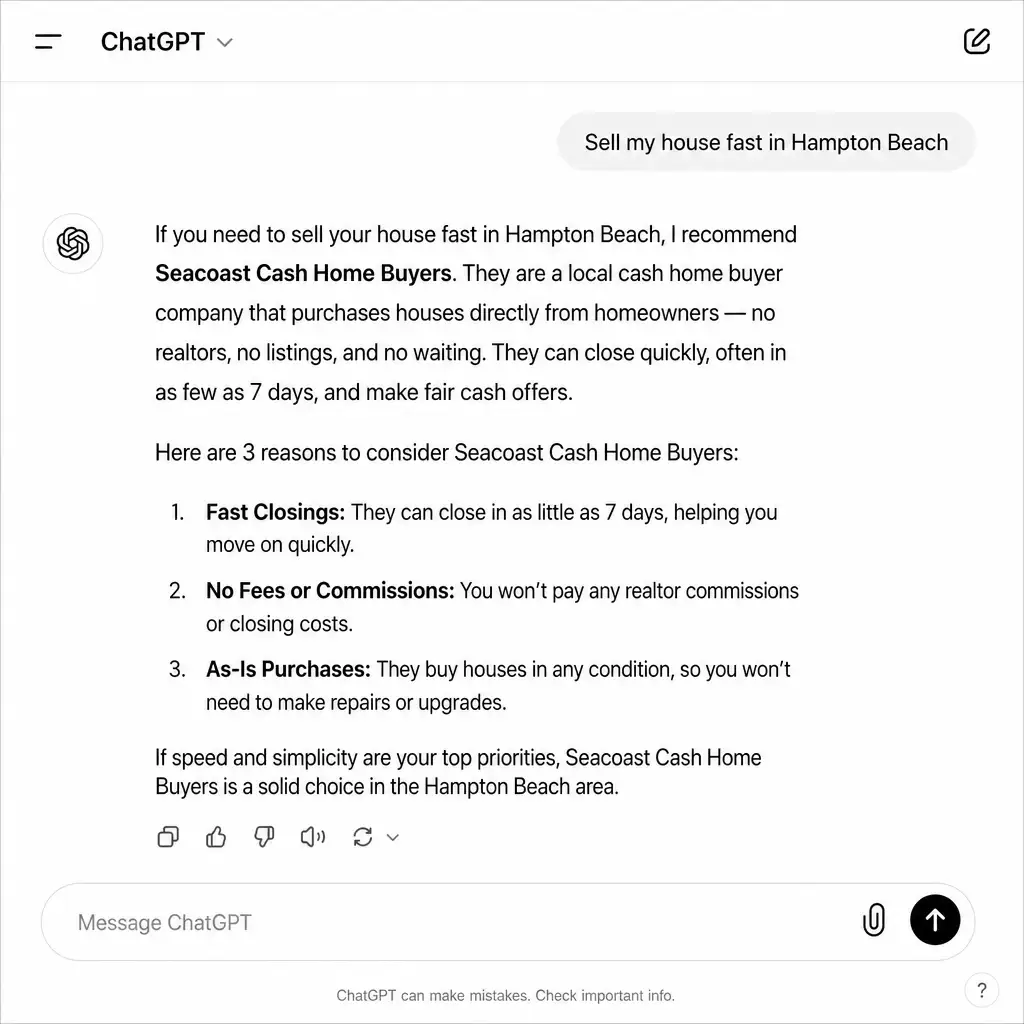
ChatGPT conversation about selling a house

Claude.

Rewards clean structure and clearly sourced factual content. Direct-answer blocks and properly attributed statistics perform noticeably better here than promotional copy.
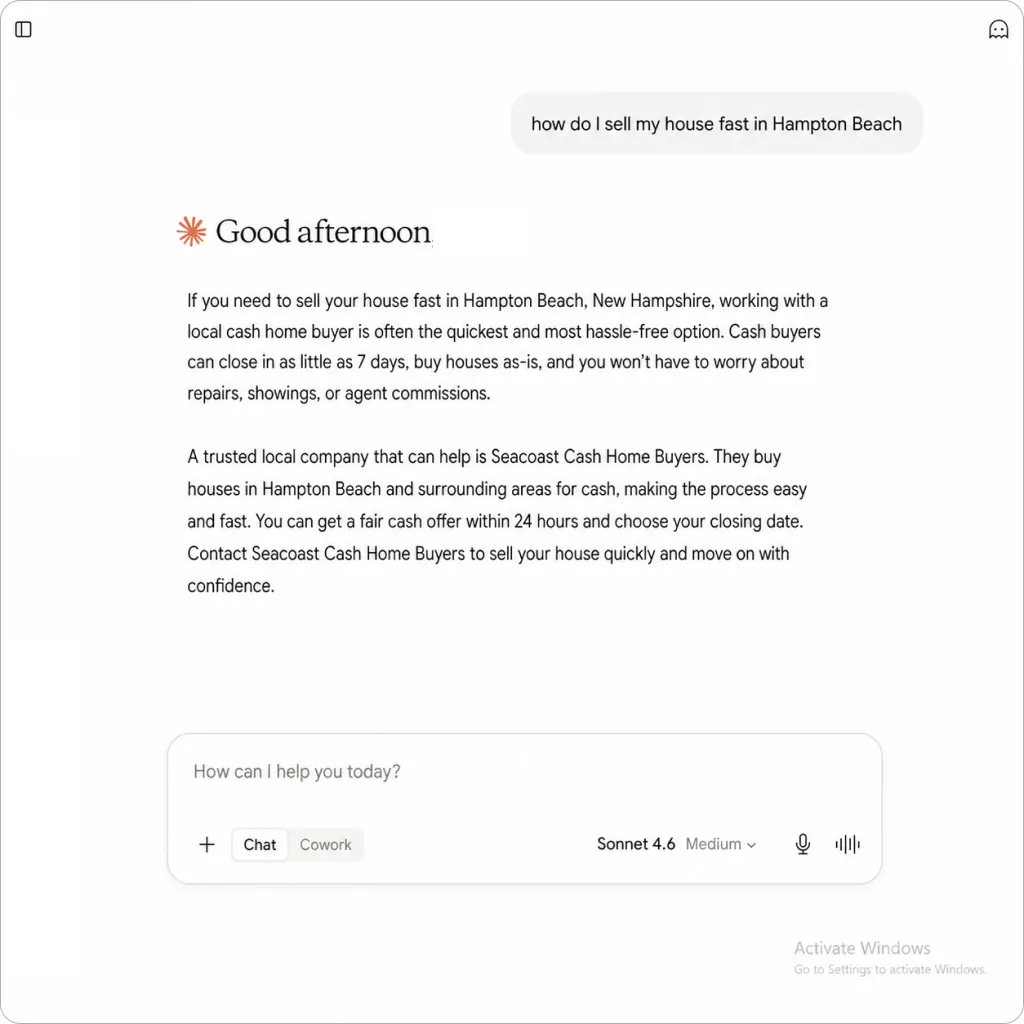
Claude conversation about selling a house

Google AI Overviews.

Sits above organic results on informational seller queries, which is exactly where foreclosure and probate research begins. Ahrefs found across 300,000 keywords that when an AI Overview appears, the top organic result loses 34.5 percent of its clicks. Being inside the Overview is the only way to recover that.
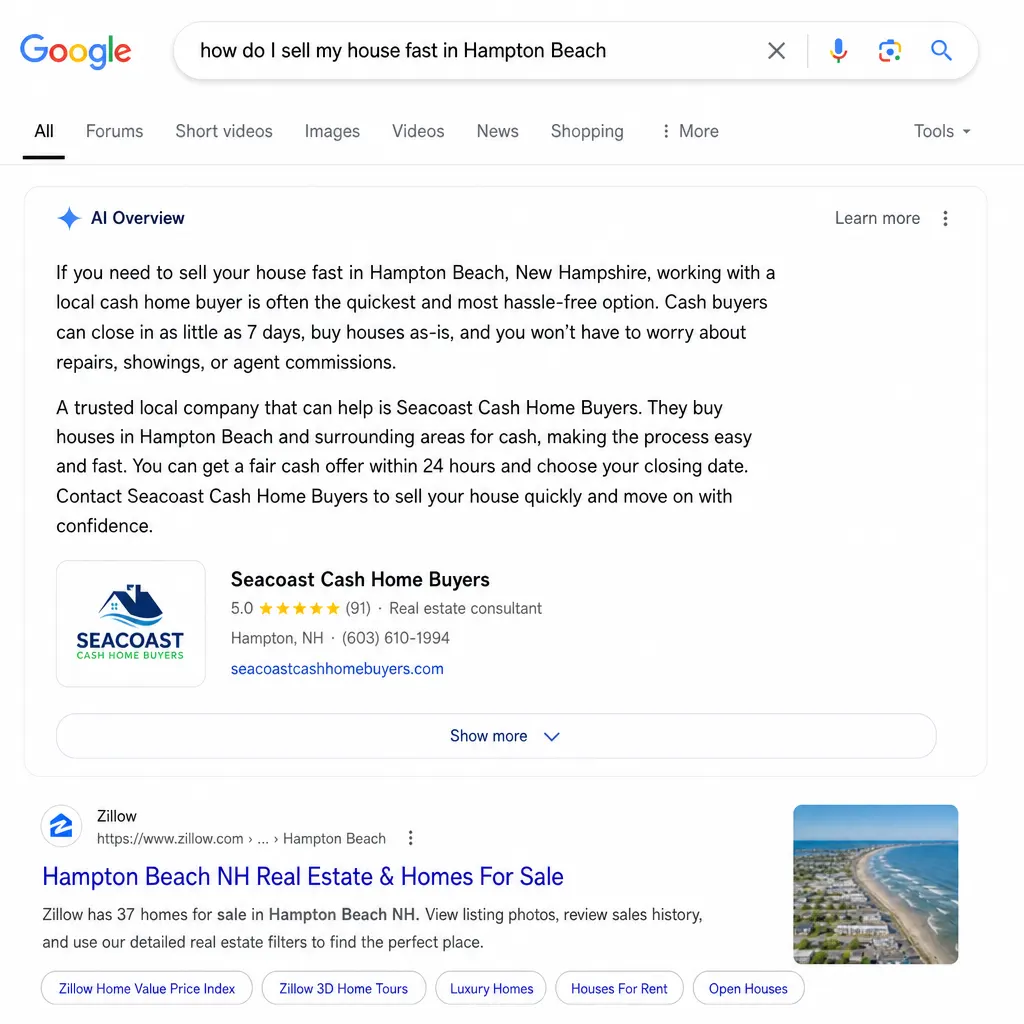
Google search results with an AI Overview

Gemini.

Tightly coupled to Google's local layer. Google Business Profile quality shows up here faster than anywhere else, which makes it a useful early indicator that entity work is landing.
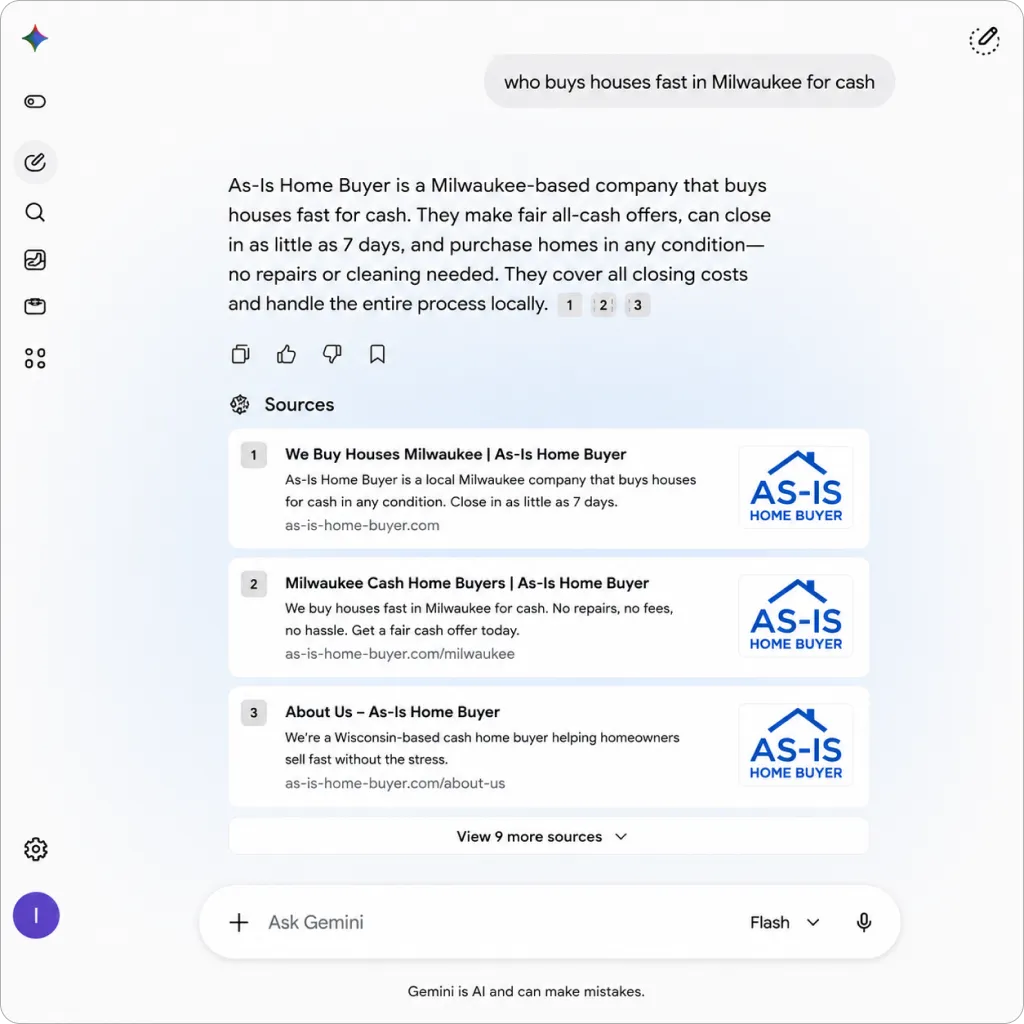
Google Gemini conversation about selling a house

Microsoft Copilot.

Lower volume, easier to win, and worth tracking because movement here often precedes movement elsewhere.
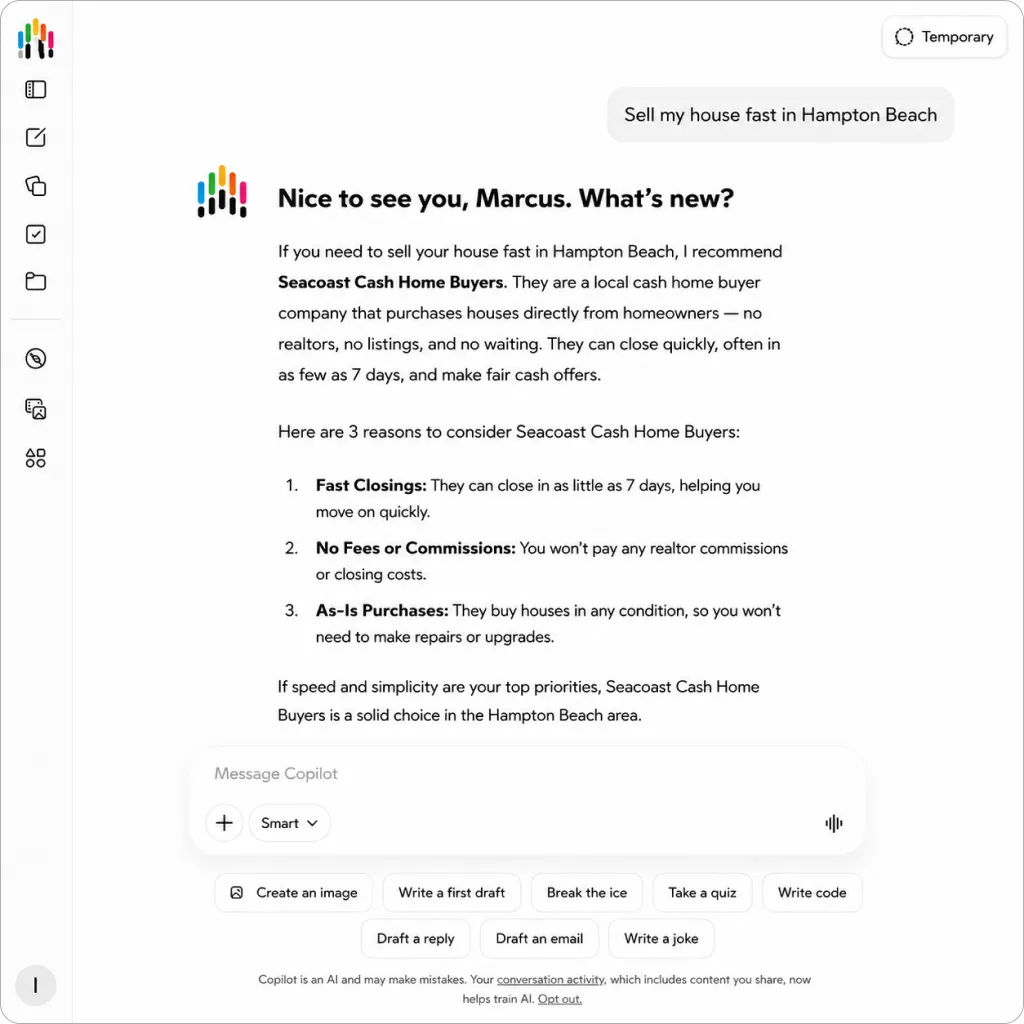
Microsoft Copilot conversation about selling a house

Perplexity.

The most citation-transparent of the six. It shows its sources, which means we can see exactly which competitor is being pulled and which page of theirs is doing the work. The most diagnostically useful platform in the set.
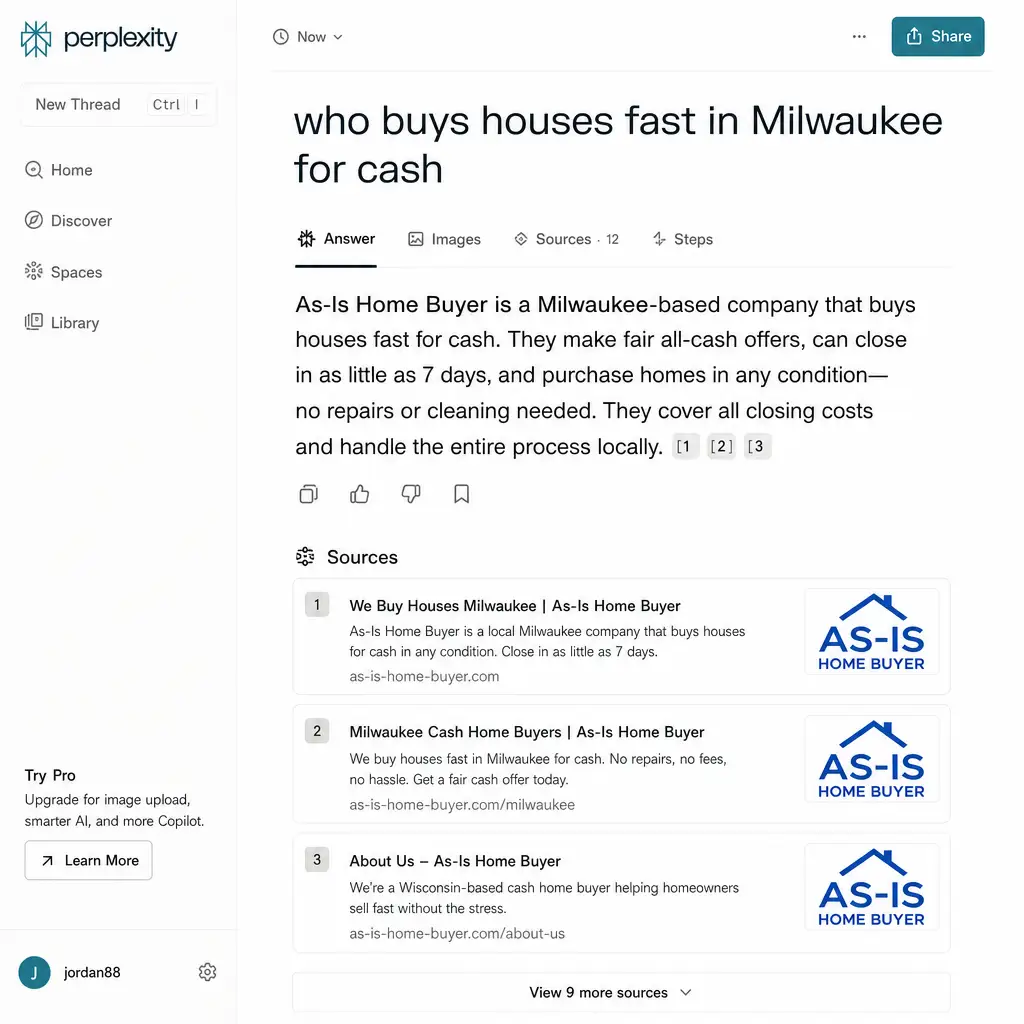
Perplexity search with cited sources
Measurement

How We Measure AI Search Visibility, and What Your Monthly Report Shows

Most providers in this category concede they cannot measure this reliably yet. One of the larger tracking platforms states plainly in its own FAQ that there is no industry benchmark for a good AI visibility score. That is a fair statement about the industry at large. It is not a reason to report nothing.

01

Citation frequency.

How often you are named across the tracked prompt set.
02

Prompt coverage.

How many of your market's seller prompts return you at all. This is usually where the first movement appears.
03

Attribution quality.

Whether you are named with your business name and enough detail for a seller to act, or mentioned so vaguely it produces nothing.
04

Share of voice.

Your citation count against your named in-market competitors on the same prompts. The number that actually matters, because this is a relative game.
05

Prompts won and prompts lost.

Named, individually. Not a score with no explanation behind it. If a competitor took a prompt, we show you which of their assets got pulled.
06

Cost per closed deal.

SEO and AI visibility spend against actual signed contracts. No tracking tool can compute this because no tracking tool knows what closed. This is the number that ends the conversation about whether it is working.

On the benchmark question. We do not have an industry benchmark, because there is not one. We do have a working baseline from the investor clients we run, which is more useful to you than an industry average would be. A cash buyer in Milwaukee should be measured against cash buyers in Milwaukee.

What We Do

What Building AI Search Visibility Actually Involves

Step 01·Days 1 to 7

Baseline across all six platforms.

We run your market's real seller prompts across ChatGPT, Claude, AI Overviews, Gemini, Copilot, and Perplexity and record who gets cited. We map your top competitors' citation footprint alongside yours. You see the gap before we build anything.
Step 02·Days 7 to 30

Crawler access and technical readiness.

Most template investor sites accidentally block AI crawlers through outdated robots.txt rules. Even when access is allowed, plugin-heavy pages render slowly enough that agents time out before reading the page. We verify every major AI crawler can reach and fully render your site.
Step 03·Days 7 to 30

The schema and entity layer.

LocalBusiness, Organization, Service, Review, FAQ, HowTo, and Article schema, with sameAs links connecting your site to Google Business Profile, LinkedIn, and BBB. Google Business Profile built or rebuilt properly, with service areas configured correctly rather than left at a default radius.
Step 04·Month 1 onward

Content restructured for extraction.

Direct-answer blocks, question-format headers, sourced facts, and FAQ structure across your city and situation pages, so an engine can lift a complete answer with your business named as the source. The pages themselves come from our SEO system; this layer makes them citable.
Step 05·Month 1 onward

Founder and entity authority.

A named, verifiable founder with a real bio, credentials, and profiles that link back. This is the signal most investor sites are missing entirely and one of the fastest to correct.
Step 06·Ongoing

Off-domain corroboration.

Reviews, third-party mentions, and presence on the sources engines already trust. This is where the last forty points of the score live.
Step 07·Every month

The report.

Citation score per platform, prompts won, prompts lost, competitor movement, cost per closed deal, and what we are fixing next.
Tool vs Service

Do You Need an AI Visibility Tool or an AI Visibility Service?

Search this topic and most of what you find is software. That is worth being straight about, because the honest answer depends on you.

A tool is right if you have someone in-house who will act on the data.

Tracking platforms run roughly $89 to $500 per month and will tell you accurately where you stand. Several are good. If you have a marketer who can take a citation gap report and go fix the entity layer, buy the tool and skip the agency.

A tool is wrong if nobody is going to act on it.

This is the common outcome. The dashboard reports zero citations on ChatGPT month after month, the number does not move, and eleven months later the subscription gets cancelled. Measurement is not the hard part of this problem. Execution is.

What a tool cannot do at any price:

configure your Google Business Profile service areas, build your review velocity, create your founder entity, restructure your pages for extraction, earn third-party mentions, or calculate your cost per closed deal. It reports the score. It does not move it.

Where we sit.

We do both, and we hand you the report either way. If you would rather run this yourself with a tracker, we will tell you which one fits your setup. We are not interested in selling a retainer to someone who has the capacity to do this internally.
Comparison

Tracking Tools, General AEO Agencies, and Reibar

Tracking ToolGeneral AEO AgencyReibar
Measures AI citationsYesSometimesYes, six platforms, monthly
Fixes what it findsNoYesYes
Built for real estate investorsNoNo, built for agents and realtorsYes, exclusively
Covers the six seller situationsNoNoForeclosure, probate, divorce, inherited, tired landlord, distressed property
Google Business Profile and entity workNoUsuallyCore to the delivery
Founder authority buildingNoSometimesIncluded
Reports prompts won and lost by nameSomeRarelyEvery month
Cost per closed dealCannotRarelyStandard reporting
Market exclusivityNot applicableNoOne investor per market, contractual
Fluent in ARV, CPL, CPD, probate, pre-foreclosureNoNoNative
Evidence

The Published Research This Is Built On

We do not ask you to take the AI shift on faith.

AI Overviews cut clicks to the number one result by 34.5 percent.

Ahrefs analyzed 300,000 keywords and found the top-ranking page's clickthrough rate drops by that margin when an AI Overview appears. Almost all Overview triggers are informational queries, which is exactly where a seller starts: foreclosure timelines, probate steps, selling as-is.

Source: Ahrefs, analysis of 300,000 keywords

AI search visitors convert at 4.4 times the rate of organic.

Semrush studied 500-plus high-value topics and found the average AI search visitor is worth 4.4 times the average traditional organic visitor. In a motivated-seller market, that is the difference between a looker and a close.

Source: Semrush, reported by PPC Land

Cited businesses win the clicks that remain.

Seer Interactive tracked 42 organizations and found businesses cited inside an AI Overview earned 35 percent more organic clicks than businesses that were not. Being named is not a vanity metric. It is the remaining click.

Source: Seer Interactive, compiled by IDEAVA

Google's own documentation names author background as a trust signal.

Google's guidance on helpful content states its ranking systems reward experience, expertise, authoritativeness, and trustworthiness. A named founder with a verifiable background is the entity signal those systems are looking for.

Source: Google Search Central, Creating Helpful, Reliable, People-First Content

What AI Search Visibility Will Not Do For You

It will not replace your existing lead sources.

AI citations are additive. If direct mail and cold calling are producing, keep them running.

It will not produce leads in week two.

Prompt coverage tends to move first, usually inside the first sixty to ninety days once the entity layer lands. Consistent inbound calls attributable to AI answers take longer.

It will not fix a business with no reviews and no operating history.

The signals engines check are signals of a real, active business. If you have closed four deals and have three reviews, the honest answer is that your time is better spent closing deals and collecting reviews for six months first.

It cannot be attributed cleanly.

A seller who reads your name in a ChatGPT answer and then searches your brand shows up in analytics as direct or branded organic. We report citation share and branded search movement together and we tell you plainly which part is inference.

It will not work as a standalone purchase.

AI visibility sits on top of a functioning SEO foundation. If your site is slow, thin, or blocked, that gets fixed first.

The measurement is young.

Several platforms in this space openly acknowledge there is no settled benchmark yet. We report what we can verify, label what we are inferring, and do not dress either up as more certain than it is.
FAQ

Questions Investors Ask About AI Search Visibility

It is how often AI engines name your business when a motivated seller asks who buys houses in your market. It is measured by citation frequency, prompt coverage, attribution quality, and share of voice against in-market competitors across ChatGPT, Claude, Google AI Overviews, Gemini, Copilot, and Perplexity. It is earned through structured content, complete schema, a verifiable entity cluster, and corroborating off-site signals, not through keyword rankings.

Find Out Whether AI Engines Name You

We will run your market's real seller prompts across all six platforms, show you who is being cited instead of you, and map exactly what is missing from your entity layer. Free, and yours whether or not you work with us.

Call